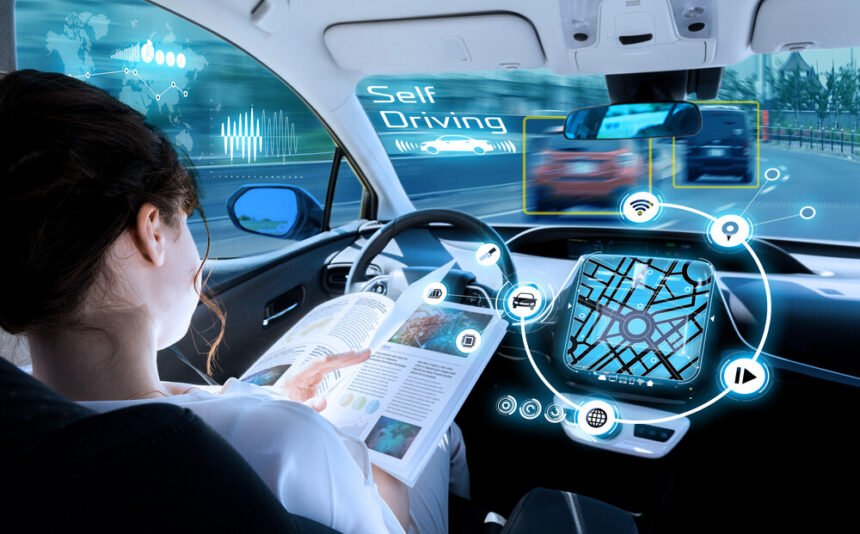
Recently, Elon Musk announced that Tesla’s next Autopilot update in August of 2018 will “enable full self-driving features.” How could Tesla be there already? The automaker is still defending itself after the most recent Autopilot fatality, in which a man let go of the steering wheel with Autopilot engaged, ignored safety cues from the computer, and slammed into a concrete barricade. Did Tesla learn an important lesson from that crash? In other words, are Tesla’s datasets now advanced enough to enable full, safe, self-driving capabilities through Autopilot? Is the company’s autonomous vehicle technology on the leading edge? There’s a lot at stake here. Elon Musk’s reputation is on the line alongside Tesla’s valuation, not to mention the lives of drivers who will trust a self-driving Tesla. For Tesla to make this work, it has to account for the fact that autonomous vehicles are only as good as the data they collect.
Autonomous Vehicle Tech and Data
In general, autonomous vehicle technology should be able to do the following:
- Sense-plan-act: In order to plan and act, the vehicle’s machine learning algorithms must be able to predict outcomes based on a high volume of data.
- Mapping: The vehicle’s computer must possess highly detailed, comprehensive maps of street features, including streetlights, signs, and curbs.
- Light detection and ranging: Using sensors such as cameras and LIDAR, the vehicle should be able to create a short-distance readout of its surroundings in real time.
- Vehicle-to-vehicle communication: Autonomous vehicle tech doesn’t have this up and running yet, but the best-case scenario would involve an IoT aspect, in which autonomous vehicles are communicating important details to each other. Projections show that more than 380 million smart cars will be a part of the IoT by the year 2021.
Additionally, sensors need to be able to tell the computer when they’re defective, which is called “graceful degradation.” Extremely accurate predictive analytics have to be able to tell when an event is about to occur, such as when a pedestrian is getting ready to cross the street, and the vehicle has to be trained well enough to be able to react appropriately. If a vehicle’s protocols tell it to obey laws 100 percent of the time, there must be an override function that tells it to do otherwise when someone’s life is at stake. The override function for Tesla’s Autopilot is the human driver, meaning Tesla hasn’t reached truly autonomous vehicle capability. But the new update indicates that Tesla is confident it’s getting close to an autonomous vehicle.
Tesla’s Data
The Verge reports that Tesla doesn’t have LIDAR, therefore Tesla doesn’t have any LIDAR data to inform its Autopilot. That’s likely to be a big impediment, as Tesla relies primarily on cameras. “I don’t think Tesla is particularly anywhere close to getting to [fully] driverless operation,” Raj Rajkumar, co-director of connected and autonomous driving research at Carnegie Mellon University, told The Verge. When it comes to driverless capability, Rajkumar and other analysts believe Tesla is at a disadvantage compared with a company like Waymo, because Waymo has LIDAR. LIDAR provides a great deal of data for a vehicle to work with, but The Verge reports that Tesla’s Autopilot relies on eight cameras, 12 ultrasonic sensors, and a forward-facing radar to provide data. Waymo, on the other hand, works with plenty of LIDAR, radar, and cameras. Tesla does have something Waymo doesn’t have: real-world data from vehicles out on the road. By July of 2017, Tesla’s fleet logged 5 billion miles. Tesla is able to collect data on speed, acceleration, braking, and battery use, and the company can access short video clips from accidents. Tesla gets plenty of autopilot data on a daily basis, and even when a car isn’t in autopilot, it can go into “shadow mode,” meaning it can provide hypothetical data on what the car would have done were it in autopilot mode.

Waymo’s Data vs. Tesla’s Data
By February of 2018, Waymo had logged 5 million miles of self-driving data with its Chrysler Pacifica minivans. Additionally, the company had logged over 5 billion miles through computer simulations. Simulation data goes toward informing the Waymo fleet, which has been operating in 25 cities throughout 5 states. Tesla, however, has been collecting data all over the world with over 300,000 vehicles. The fact that Tesla’s autopilot is semi-autonomous allows its vehicles to drive anywhere drivers dare to go, meaning Tesla’s sensors can collect data on all sorts of terrain. Although Tesla’s data doesn’t include LIDAR data, “A forward-facing radar with enhanced processing provides additional data about the world on a redundant wavelength that is able to see through heavy rain, fog, dust and even the car ahead,” the company’s website claims. Tesla cameras provide visibility, and thus collect data, at a range of 250 meters in all directions. With the new update in August, the onboard computer will be able to process data 40 times faster than before. Still, Waymo’s data is more detailed because of LIDAR. That doesn’t matter to Tesla. “The system is designed to be able to conduct short and long distance trips with no action required by the person in the driver’s seat,” Tesla’s site says. This could minimize the risks of accidents caused by human error, which could reduce insurance costs. As a result, it could lower insurance rates.
Will Tesla Win?
There’s a sense in which Tesla will win, and there’s a sense in which it will not. The legality of self-driving cars places Tesla in a grey area, because if a car is actually autonomous, a judge could rule that the company faces product liability in case of a crash, thereby releasing the driver from negligence charges. Tesla’s cars will not technically be autonomous because a driver will be behind the wheel, meaning the driver could still be liable. However, Tesla’s “park seek mode” function allows the car to park itself with no driver in the car. Since that technically would qualify the vehicle as being autonomous, Tesla admits the rollout of its “full self-driving capability” is “dependent on local regulatory approval.” Waymo, on the other hand, is already cleared to introduce a driverless taxi service in Arizona towards the end of 2018. Waymo’s Chrysler Pacifica minivans will be fully autonomous. Waymo is winning in the race for a fully autonomous vehicle, but Tesla is winning in the race to put self-driving vehicles in the hands of consumers. Ultimately, safety will determine the winner. Even if Tesla is beating Waymo to the punch of delivering a self-driving option for consumers, any more Autopilot accidents will mar the rollout. If Waymo achieves a better track record, it will prove that computer simulations and LIDAR data are more effective for autonomous vehicles than Tesla’s data.